The Cost of Smoking: Financial Calculator
The Real Cost of Smoking: The Numbers That Should Make You Angry
We talk a lot about the health reasons to quit smoking. Lung cancer. Heart disease. COPD. And those are all excellent reasons.
But let’s be honest: sometimes your wallet talks louder than your lungs.
So let’s talk money. Not vague, hand-wavy “smoking is expensive” platitudes. Real numbers. Specific math. The kind of calculations that make you stare at the ceiling at 2 AM wondering what you’ve been doing with your life.
The Direct Cost: Cigarettes
Let’s start with the obvious one. What you spend on cigarettes.
The average price of a pack of cigarettes in the United States in 2025-2026 varies wildly by state, from about $6.00 in Missouri to $13-15 in New York and Connecticut. The national average sits around $8-9 per pack.
Here’s what pack-a-day spending looks like at different price points:
At $8.00/Pack (Low-Cost States)
| Timeframe | Cost |
|---|---|
| Per day | $8.00 |
| Per week | $56.00 |
| Per month | $243 |
| Per year | $2,920 |
| Over 5 years | $14,600 |
| Over 10 years | $29,200 |
| Over 20 years | $58,400 |
At $10.00/Pack (Mid-Range States)
| Timeframe | Cost |
|---|---|
| Per day | $10.00 |
| Per week | $70.00 |
| Per month | $304 |
| Per year | $3,650 |
| Over 5 years | $18,250 |
| Over 10 years | $36,500 |
| Over 20 years | $73,000 |
At $13.00/Pack (High-Cost States: NY, CT, etc.)
| Timeframe | Cost |
|---|---|
| Per day | $13.00 |
| Per week | $91.00 |
| Per month | $395 |
| Per year | $4,745 |
| Over 5 years | $23,725 |
| Over 10 years | $47,450 |
| Over 20 years | $94,900 |
Read that last number again. Nearly $95,000 over 20 years for a pack-a-day smoker in a high-cost state. And that’s assuming prices don’t go up — which they always do. Cigarette prices have increased by an average of 4-6% per year over the past two decades due to tax increases and manufacturer pricing.
With Price Inflation (4% Annual Increase)
If we factor in the 4% average annual price increase, the real 20-year cost for a pack-a-day smoker at today’s $10/pack becomes:
| Timeframe | Inflation-Adjusted Cost |
|---|---|
| 5 years | $19,800 |
| 10 years | $43,800 |
| 20 years | $109,200 |
Over a hundred grand. On fire. Literally.
Half-Pack-a-Day Smoker
Not a pack a day? Here’s the math at $10/pack for a half-pack smoker:
| Timeframe | Cost |
|---|---|
| Per year | $1,825 |
| Over 10 years | $18,250 |
| Over 20 years | $36,500 |
Still a used car. Or a year of college tuition at a state university.
The Hidden Costs: The Ones You’re Not Counting
Here’s where it gets ugly. Cigarettes are actually the cheapest part of the smoking habit. The indirect costs dwarf the price of the packs themselves.
Health Insurance Premiums
Under the Affordable Care Act, health insurers can charge smokers up to 50% more in premiums. This is the only health factor (besides age) that the ACA allows insurers to use for pricing.
The average annual premium for an individual health insurance plan in 2025 is approximately $7,900 (Kaiser Family Foundation data). A 50% surcharge is $3,950 per year.
In practice, most insurers charge a 15-25% surcharge rather than the full 50%, which works out to $1,185-$1,975 per year in extra premiums.
Over 20 years, at a 20% surcharge: $31,600 in extra insurance costs alone.
And if your employer offers a wellness program with a tobacco surcharge (increasingly common), you might face an additional $1,000-$2,000 per year on top of that.
Life Insurance
This one is brutal.
A healthy 35-year-old non-smoker can get a $500,000 20-year term life insurance policy for roughly $25-35/month.
The same policy for a smoker? $90-150/month.
That’s an extra $780-$1,380 per year — or $15,600-$27,600 over 20 years — just because you smoke. Smokers pay 2-4 times more for life insurance across the board.
Dental Costs
Smoking causes gum disease, tooth decay, and tooth loss at dramatically higher rates than non-smoking. The American Dental Association estimates that smokers incur $1,000-$2,500 per year in additional dental costs over their lifetime, including:
- More frequent cleanings (smoke staining, increased plaque)
- Gum disease treatment ($500-$3,000 per treatment)
- Tooth replacement from premature loss ($1,000-$5,000 per implant)
- Cosmetic procedures to address discoloration
Over 20 years: $20,000-$50,000 in extra dental costs.
Healthcare Costs (General)
The CDC estimates that smoking-related healthcare costs average $1,623 per smoker per year in excess medical expenditures. This includes higher rates of doctor visits, medications, hospital stays, and treatment for smoking-related conditions.
That’s on average — meaning some smokers pay far more (anyone who develops COPD, cancer, or heart disease) and some pay less. But over a lifetime, the average excess healthcare cost attributable to smoking is estimated at $170,000 per smoker (Campaign for Tobacco-Free Kids, based on CDC data).
Lost Productivity and Earnings
Smokers earn less than non-smokers. This is documented across multiple studies:
- A 2013 study in JAMA Internal Medicine found that smokers earned $3,300-$8,300 less per year than comparable non-smokers, even after controlling for education, occupation, and demographics.
- Smokers take more sick days — an average of 2.5 extra sick days per year (CDC, 2018).
- Smoke breaks cost employers an estimated 6 days of productivity per year per smoker. While you might think this doesn’t cost YOU money, employers factor this into hiring decisions, promotions, and raises.
Over 20 years, at a conservative estimate of $4,000/year in reduced earnings: $80,000 in lost income.
Homeowner and Renter Costs
- Home resale value: Smoking in a home reduces its resale value by 20-29%, according to Realtor.com surveys. On a $300,000 home, that’s $60,000-$87,000 in lost equity.
- Professional cleaning when selling: $3,000-$15,000 to remove smoke damage, replace carpets, repaint, and remediate odor.
- Renter’s premium: Many landlords charge smokers higher deposits or add pet-style surcharges. Some won’t rent to smokers at all, limiting your options to lower-quality units.
Vehicle Costs
- Resale value: Smoke-exposed cars sell for $500-$2,000 less than clean equivalents, depending on the vehicle’s value.
- Professional detailing to remove smoke odor: $200-$500 per treatment.
- Interior cleaning and replacement: $500-$2,000 for deep cleaning, headliner replacement, and odor treatment.
Cosmetic and Personal Costs
These are harder to quantify but real:
- Teeth whitening: $300-$1,000+
- Skin care to address premature aging: $200-$500/year
- Dry cleaning and laundry increases (smoke odor): $200-$400/year
- Air fresheners, candles, and odor management: $100-$300/year
- Lighters and accessories: $50-$100/year
The Total Picture: What Smoking Actually Costs
Let’s add it all up for a pack-a-day smoker at $10/pack over 20 years:
| Category | 20-Year Cost |
|---|---|
| Cigarettes (with 4% inflation) | $109,200 |
| Health insurance surcharges | $31,600 |
| Life insurance surcharges | $20,000 |
| Excess dental costs | $30,000 |
| Excess healthcare costs | $32,460 |
| Lost earnings | $80,000 |
| Home value impact | $60,000+ |
| Vehicle impact | $5,000 |
| Cosmetic/personal costs | $12,000 |
| TOTAL | $380,000+ |
Three hundred and eighty thousand dollars. Over 20 years.
And I’ve been conservative with several of these estimates.
The CDC’s own figure, when factoring in healthcare costs, lost productivity, and premature death, puts the lifetime economic cost of smoking at over $630,000 per smoker.
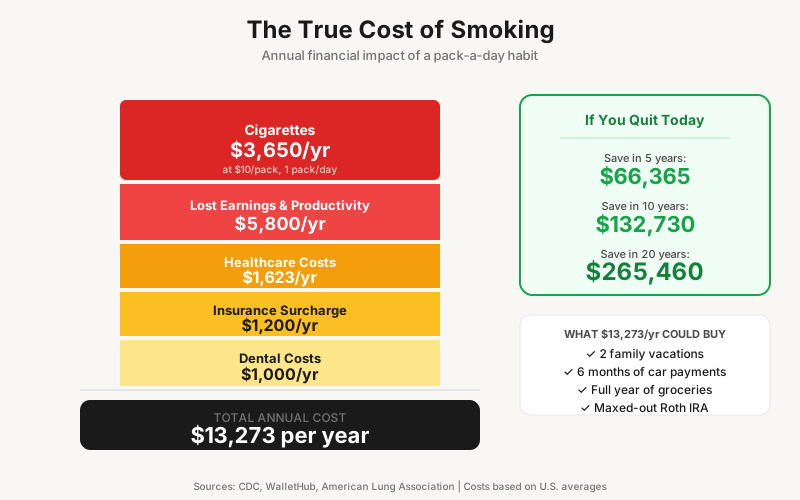 The true cost of smoking beyond just cigarettes — Sources: CDC, 2023; Campaign for Tobacco-Free Kids, 2024; Kaiser Family Foundation, 2024
What You Could Buy Instead
Because abstract numbers don’t hit as hard as concrete examples. Here’s what your cigarette money could become:
With $3,650/Year (Pack-a-Day at $10/Pack):
- A vacation every year. A solid week-long trip to Cancun, the Caribbean, or a European city runs $1,500-$3,500.
- A new car every 7-8 years. If you invested $3,650/year at a modest 6% return, you’d have about $30,000 in 7 years.
- Your kids’ college fund. $3,650/year invested from birth to age 18 at a 7% average return = approximately $130,000. That’s a state university education fully funded.
- A down payment on a house. In just 5 years of saving cigarette money, you’d have $18,250 — more than the minimum down payment on homes in many U.S. markets.
With $10,000/Year (True Total Annual Cost Including Hidden Costs):
- Retirement security. $10,000/year invested from age 30 to 65 at a 7% average market return = $1,470,000. You’d be a millionaire. From. Not. Smoking.
- A rental property. In 3-4 years, you’d have enough for a down payment on an investment property generating passive income.
- Financial freedom. $10,000/year is $833/month. That’s a car payment you don’t have. A student loan you could pay off early. An emergency fund that actually exists.
Let that sink in: the difference between financial stress and financial security might literally be the habit you’re trying to quit.
The Investment Calculator: Time Value of Money
This is the number that really stings. Money saved from not smoking doesn’t just sit there — if invested, it grows.
Here’s what happens if you quit at age 30 and invest just the cigarette cost ($3,650/year at $10/pack) in an S&P 500 index fund averaging 7% annual returns:
| Age | Total Invested | Portfolio Value |
|---|---|---|
| 35 | $18,250 | $22,300 |
| 40 | $36,500 | $53,600 |
| 45 | $54,750 | $98,000 |
| 50 | $73,000 | $161,000 |
| 55 | $91,250 | $251,000 |
| 60 | $109,500 | $377,000 |
| 65 | $127,750 | $552,000 |
Over half a million dollars. From not buying cigarettes and putting that money somewhere boring and predictable instead.
And if you include the hidden costs — the insurance surcharges, the healthcare savings, the increased earnings — and invest the total differential? You’re looking at north of $1.5 million by retirement.
The Vaping Cost Comparison
If you’ve switched to vaping, the numbers are different but still significant:
Disposable Vapes (Elf Bar, Lost Mary, etc.)
- $15-25 per device, lasting 3-7 days
- Annual cost: $780-$3,000+ depending on usage
Pod Systems (JUUL, etc.)
- Device: $10-35
- Pods: $4-5 each (JUUL), pack of 4 for $16-20
- Heavy users go through 1+ pod per day
- Annual cost: $1,460-$2,500+
Refillable Systems
- Device: $30-100
- Liquid: $15-30 per 30ml bottle, lasting 1-3 weeks
- Coils: $3-5 each, lasting 1-3 weeks
- Annual cost: $500-$1,200
Vaping is cheaper than smoking in most cases, but it’s not free. And the hidden health costs of vaping, while likely lower than smoking, are still being studied. You’re not saving as much as you think.
The Cost of Quitting (Spoiler: It’s a Bargain)
For comparison, here’s what quitting tools cost:
| Cessation Method | Cost | Break-Even vs. Smoking |
|---|---|---|
| Cold turkey | $0 | Immediate |
| Nicotine patches (12 weeks) | $150-300 | 2-4 weeks of not buying cigarettes |
| Nicotine gum (12 weeks) | $150-250 | 2-4 weeks |
| Combination NRT (12 weeks) | $250-450 | 4-6 weeks |
| Varenicline/generic (12 weeks) | $200-600 | 3-8 weeks |
| 1-800-QUIT-NOW counseling | $0 | Immediate |
| Allen Carr’s book | $15 | 2 days |
| Smoke Free app (premium) | $5/month | 1 day |
Every cessation method pays for itself within 2 months at most. Most pay for themselves within weeks. And then the savings compound for the rest of your life.
Quitting smoking is quite literally the best financial decision most smokers will ever make, dollar-for-dollar, ahead of almost any investment strategy.
A Note About Fairness
I want to acknowledge something: smoking is disproportionately concentrated among lower-income populations. The CDC’s data consistently shows that people below the poverty line smoke at nearly double the rate of those above it. This means the financial burden of smoking falls hardest on those who can least afford it.
This isn’t an accident. The tobacco industry has historically targeted low-income communities with heavier marketing, more retail presence, and pricing strategies designed to maintain addiction. Menthol cigarettes, which are harder to quit than regular cigarettes, were disproportionately marketed to Black communities for decades.
I bring this up not to blame anyone — getting addicted to a product literally engineered to be addictive isn’t a personal failure — but to underscore that the financial freedom that comes from quitting is most transformative for those who are already financially stretched.
If cost is a barrier to cessation aids, call 1-800-QUIT-NOW. Most state quitlines provide free NRT (patches, gum, or lozenges). Medicaid covers cessation treatments in all states. Many community health centers offer free cessation programs. The tools are available — you just need to know where to look.
The Question You Should Be Asking
Forget “can I afford to quit?” The question is: can you afford not to?
At $380,000+ in total lifetime costs, smoking is one of the most expensive habits a person can have. More expensive than a daily Starbucks habit. More expensive than a golf membership. More expensive than most car payments.
And unlike those things, smoking gives you nothing in return except disease, dependency, and the illusion that you need it.
The bottom line: Smoking costs a pack-a-day smoker $3,650-$4,750/year in direct cigarette costs alone. When you add insurance surcharges, healthcare costs, lost earnings, home and vehicle depreciation, and other hidden costs, the true annual cost exceeds $10,000. Over 20 years, that’s $380,000+. Every quit attempt — even the ones that “fail” — saves you money for however long you stay quit. The math is not on smoking’s side.
Sources and Further Reading
- CDC. “Economic Trends in Tobacco.” 2023.
- Campaign for Tobacco-Free Kids. “The Toll of Tobacco in the United States.” 2024.
- Kaiser Family Foundation. “Employer Health Benefits Survey.” 2024.
- U.S. Bureau of Labor Statistics. “Average Price Data: Cigarettes.” 2025.
- Berman, M., et al. “Estimating the Cost of a Smoking Employee.” Tobacco Control, 2014.
- Halpern, M.T., et al. “Impact of Smoking Status on Workplace Absenteeism and Productivity.” Tobacco Control, 2001.
- Realtor.com. “How Smoking Affects Home Resale Values.” Survey data, 2019.
- Vogl, M., et al. “Smoking and Health-Related Quality of Life in English General Population.” BMC Public Health, 2012.
- Tax Foundation. “State Cigarette Tax Rates.” 2025.
- Xu, X., et al. “Annual Healthcare Spending Attributable to Cigarette Smoking.” American Journal of Preventive Medicine, 2015.